What to Expect on a Columbia Glacier Cruise
The day-of guide: where to check in, what the six hours actually look like, why the boat stops short of the glacier, and exactly what to wear.
Most disappointment on a Columbia Glacier cruise is manufactured before anyone leaves the dock, by a mental image of a blue wall calving into the sea. That image is real — it just belongs to a different glacier, forty miles north. Knowing what Columbia Bay actually offers turns the same six hours into one of the better days of an Alaska trip.
Here is the day, in order.
Check Availability
Check-in: an hour before, on North Harbor Drive
The Columbia Glacier & Wildlife Cruise checks in at the Stan Stephens office, a small building on pilings above the Tour Dock at 112 N Harbor Drive, immediately behind the Best Western. Check-in opens an hour before departure and boarding 30 minutes before.
Park along North Harbor Drive and walk in. There is a ramp down to the dock which, at low tide, is steep — the crew will help anyone who wants a hand, but say so at check-in rather than at the top of the ramp. Transfers to and from RV parks inside the core town are included; hotel pickup is not, though nothing in downtown Valdez is more than a few minutes’ walk away.
The first hour: Port Valdez and the Narrows
The boat crosses Port Valdez past the oil terminal and the fishing fleet while the guide runs through the history — early explorers, the pipeline, commercial fishing — and the coastal mountains drop waterfalls straight into the water on both sides.
Then the Valdez Narrows, a genuine squeeze between headlands, and you are out in Prince William Sound. This is roughly when the soup appears.
The middle: a wildlife cruise that happens to be going somewhere
The reason six hours is not too long for the distance is that the boat keeps stopping.
- Near-certain: sea otters, rafted on their backs in the kelp; bald eagles.
- Very likely: harbour seals hauled out on floating ice; Steller sea lions on the rocks.
- Common: Dall’s porpoise, which ride the bow wave.
- A good day: humpback whales, orca, puffins.
Crews hunt for this actively and hold position when they find it. Binoculars change the experience more than any other single item you can bring.
Columbia Bay: why the glacier stays at a distance
You feel the bay before you see it — the air temperature drops, brash ice thickens around the hull, then bergy bits, then bergs the size of a house, blue where centuries of pressure have squeezed the air out of them.
And then, on most days, the boat stops well short of the glacier itself.
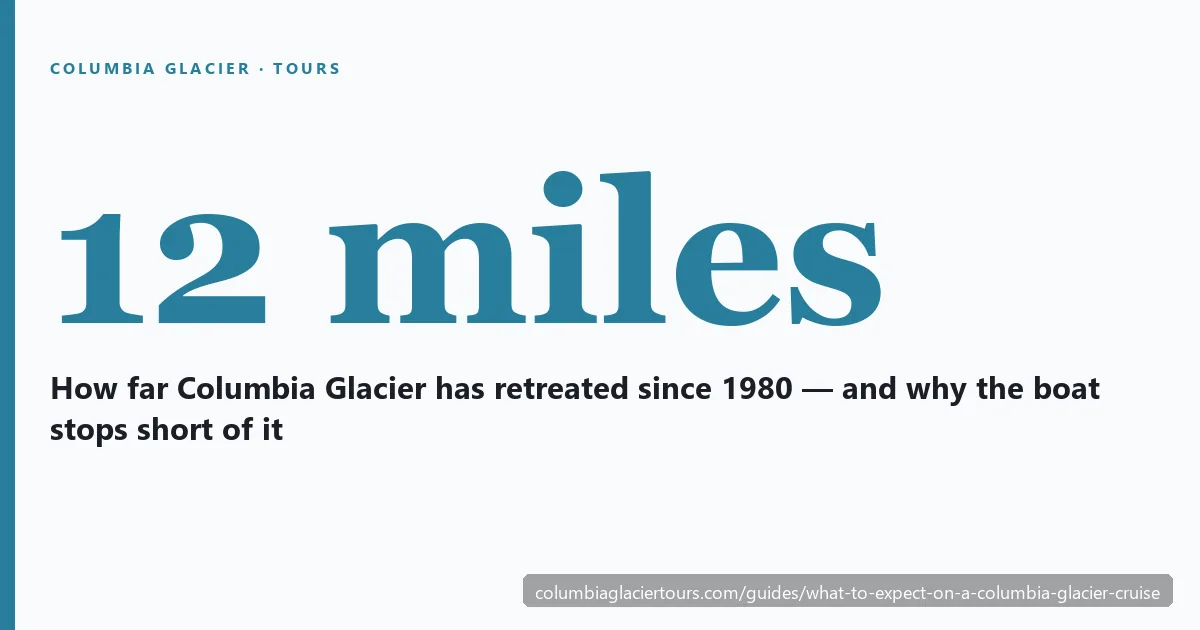
This is not the captain being cautious for the sake of it. When British surveyors mapped this coast in 1794, Columbia Glacier’s snout reached Heather Island near the mouth of the bay, and it stayed roughly there for nearly two centuries. Since the early 1980s it has retreated more than 12 miles and lost over half its thickness and volume. What it left behind is a submerged terminal moraine — the ridge of rock and gravel it built while it was grounded at the bay mouth — and that ridge now traps the icebergs the glacier keeps calving.
So Columbia Bay is not open water with ice at the end. It is miles of packed, drifting bergs that rearrange themselves every tide, and how far in a boat gets is decided that morning by the ice, the wind and the water. On a light-ice day the terminus appears as a low white band several miles off with the Chugach stacked behind it. On a heavy day the field is the destination.
Both are the same story at different distances, and the second one is arguably the more honest view of what is happening to this glacier. But if a calving face is what you came for, book the Meares Glacier cruise instead — the crews themselves will tell you so when Columbia Bay is heavy. Our breakdown of the Meares cruise →
What to wear, specifically
Dress for conditions well below whatever Valdez feels like on the dock, then add wind chill from a moving boat. The cabin is enclosed and heated; the outside decks are where the trip actually happens.
- A warm mid-layer — fleece or down, not a hoodie
- A waterproof shell; departures run in any weather
- Hat and gloves, which is the pair people most often skip and most regret
- Closed-toe shoes for the dock ramp and wet decks
- Sunglasses and sunscreen — glare off ice and water is real even under cloud
- Binoculars, cash for the snack bar and gratuities
Bring your own snacks if you have particular dietary needs; the included light lunch is soup, a bagel with cream cheese and cookies, and the galley is small. Guests may bring food and soft drinks aboard, but no alcohol.
Getting back, and what to do with the rest of the day
The 6-hour cruise is back by mid-afternoon, which leaves a full Valdez evening. If you have another day, the three-hour Duck Flats paddle is the easiest add-on in town, and the nine-hour kayak day is the same bay from a metre above the water.
If you are still choosing, the which-tour guide settles it in four questions, and the best-time guide covers how the season changes your odds.
See Columbia Glacier While It Is Still Columbia Bay
The glacier has pulled back more than 12 miles since 1980, and the bay it left behind is packed with its ice. Day boats and kayaks run out of Valdez from roughly mid-May to mid-September. Free cancellation on every tour here.
Check Availability & Book